
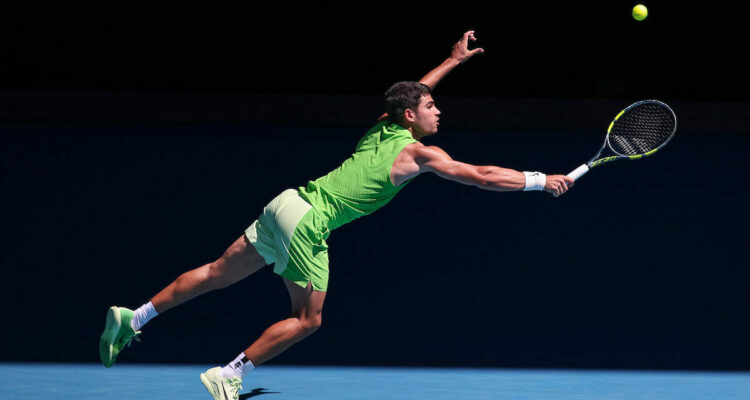
MELBOURNE/WASHINGTON, January 30, 2026 (by Michael Dickens)
World No. 1 Carlos Alcaraz of Spain and World No. 3 Alexander Zverev of Germany are no strangers to one another on a tennis court. After all, before Friday’s first semifinal at the Australian Open, they had met 12 previous times – including four times at a Grand Slam – and were dead even in their head-to-head series. Each player had won six and lost six overall, 2-2 in majors.
In their 13th meeting, Alcaraz broke the tie – but not before his body began to fail him just two games from a straight-set victory in what would eventually become the longest Australian Open semifinal in tournament history.
Now, after surviving a five-hour, 27-minute thriller in his 10th major semifinal – his first at Melbourne Park – the 22-year-old Alcaraz has become the youngest player to reach all four major finals in the Open Era. Alcaraz defeated Zverev, 6-4, 7-6 (5), 6-7 (3), 6-7 (4), 7-5, before a sold-out Rod Laver Arena. It was the longest match of this year’s tournament and third-longest match in Melbourne Park history.
just epic pic.twitter.com/PPWOcrhDxg
— #AusOpen (@AustralianOpen) January 30, 2026
Alcaraz, a winner of six majors, will face 10-time AO champion Novak Djokovic of Serbia, who fought past two-time reigning champion Jannik Sinner of Italy, 3-6, 6-3, 4-6, 6-4, 6-4, in four hours and nine minutes, for the Australian Open title on Sunday evening.
“I always say that you have to believe in yourself not matter what,” said Alcaraz, who overcame mental exhaustion and physical struggles with cramping in his upper right leg. “No matter what you’re struggling [with, what] you’ve been through, no matter anything, you got to still believe in yourself all the time.
“I was struggling in the middle of the third set. Physically, it was one of the most demanding matches that I have ever played in my short career, I would say, but I’ve been in these kinds of situations.
“I’ve been [in] this kind of match before. So, I knew what I had to do. I had to put my heart into the match. I think I did it. I fought until the last ball. I knew that I was going to have my chances. I was passionate, you know, in the fifth set, but just extremely proud about myself, the way that I felt and the way that I came back.”
Longest semifinal in Australian Open history https://t.co/IT1ZlJHpvu
— #AusOpen (@AustralianOpen) January 30, 2026
Alcaraz had never lost after taking a two-set lead – and he hadn’t dropped a set all tournament. He was two points from a straight-set semifinal victory, ahead 5-4 in the third set, when he began to cramp. Following a medical timeout for treatment on his upper right leg and massages on the affected area at two subsequent changeovers, Alcaraz played on – even if his foot work and speed weren’t always up to his usual standard.
60-0 https://t.co/6K5v4BXHmC pic.twitter.com/mKGgkBrzfV
— #AusOpen (@AustralianOpen) January 30, 2026
In the final set, Alcaraz was broken in the first game, but stayed close to Zverev, who was victorious in his only previous meeting against Alcaraz at the Australian Open, recording a four-set victory in the 2024 quarterfinals.
After five missed break-point chances without being able break his opponent, Alcaraz converted a break point as Zverev was serving for the match at 5-4. He held for 6-5. Then, with the German serving to stay in the match, Alcaraz won on his first match-point opportunity. He denied Zverev, who was vying for his four major final and second-straight in Melbourne.
Sascha, thankyou for helping bring to life one of the most epic #AusOpen matches in history and a great #AO26 campaign @wwos • @espn • @tntsports • @wowowtennis • #AO26 pic.twitter.com/Hm3XzRjDfO
— #AusOpen (@AustralianOpen) January 30, 2026
Alcaraz finished the semifinal victory with 78 winners – 12 of them aces – and won 74 percent (89 of 121) of his first-serve points. He made 58 unforced errors, converted four of 14 break points and outpointed Zverev 200-194. Zverev ended with 56 winners – including 17 aces – and converted two of seven break points.
“Unbelievable fight, battle. Unfortunate ending for me, but to be honest, I had absolutely nothing left in me,” Zverev said during his post-match news conference.
“To be honest, I think I’m way too tired to have emotions right now, so like in two days, I’ll probably have more, but right now I’m just exhausted,” the German later continued. “I think we both went to our absolute limits, so somewhat I’m also proud of myself, the way I was hanging on and came back from two sets to love.
“Of course it’s disappointing, but this is the start of the year, so if I continue playing that way, if I continue training the way I train, if I continue working on the things that I’ve been working in the offseason, I do believe it’s going to be a good year for me.”
Meanwhile, Alcaraz will soldier on to his first AO final. “I’m just really happy to have the chance to play for my first final here in Melbourne,” he said. “It is something that I was pursuing a lot, chasing a lot, having the chance to fight for the title.”
A match we’ll remember forever.
Thankyou, Alex and Carlos pic.twitter.com/YpuuqZMQT7
— #AusOpen (@AustralianOpen) January 30, 2026
Gadecki and Peers repeat their mixed doubles success
It’s been 37 years since there’s been back-to-back mixed doubles champions – and 62 years since it’s been done by Australians. Friday afternoon on Rod Laver Arena, Australian wild cards Olivia Gadecki and John Peers rallied from a set down to defeat unseeded French pair Kristina Mladenovic and Manuel Guinard, 4-6, 6-3, 10-8, in one hour and 33 minutes to successfully defend their Australian Open mixed doubles title.
Gadecki and Peers shared an on-court connection that blended their excellent communication skills with high tennis IQs. When combining Gadecki’s serving skills with Peers’ dominating net play, it’s no wonder that they won last year’s Australian Open mixed doubles title and marched to another title in Melbourne in 2026.
The first pair to successfully defend their title at the #AusOpen since Jana Novotna and Jim Pugh in 1989 ✅
The first all-Aussie pair to do so since Margaret Court and Ken Fletcher, 62 years ago ✅Gadecki/Peers, you legends pic.twitter.com/FCx0hhSxiw
— #AusOpen (@AustralianOpen) January 30, 2026
The Australian duo became the first mixed doubles team to go back-to-back at the Australian Open since Jim Pugh and Jana Novotna did it in 1988-89. They were also the first Australian team to win the AO mixed doubles crown since Margaret Court and Ken Fletcher in 1963-64.
It was the third Grand Slam mixed doubles title for Peers, after also winning the 2022 US Open with Storm Sanders. Peers also won the AO 2017 men’s doubles crown with Henri Kontinen of Finland and earned a gold medal at the 2024 Paris Olympic Games with Matthew Ebden.
Gadecki, 23, and Peers, 37, won the title on their first championship point in the match tie-break with Peers serving. He hit a second serve that Guinard netted with a forehand return. The champions hit 15 winners – including six aces – and converted three of seven break points. They outpointed Mladenovic and Guinard 63-59.
#AO26 mixed doubles champions take up the ‘try not to smile’ challenge pic.twitter.com/VL4m598E1u
— #AusOpen (@AustralianOpen) January 30, 2026
“To hold the trophy again this year is incredible,” Gadecki said during the trophy ceremony after thanking Peers. “I knew we could do it [repeat], but I didn’t think we could really do it. … It was such a special final.”
“Guys, [it’s been an] unbelievable week,” Peers said. Then, in praising Mladenovic and Guinard, he added: “You put in a great effort, there’s definitely more to come. So, enjoy it. Congratulations on a great week.
“We had great fun this week. I’m enjoying every moment out here. Hopefully, we can do it a few more times.”
That winning feeling never gets old pic.twitter.com/JLrb6E3WiJ
— #AusOpen (@AustralianOpen) January 30, 2026
Around the Australian Open
Saturday promises to be a busy day – it’s Day 14 at the Australian Open. The penultimate day of the Happy Slam culminates with the women’s singles final between No. 1 seed Aryna Sabalenka and No. 5 seed Elena Rybakina on Rod Laver Arena. Also, the men’s and women’s doubles finals will take place, as well as men’s, women’s and quad wheelchair singles finals.
Friday’s Australian Open results
Saturday’s Australian Open order of play
Quick hits
KIA Arena was the site for wheelchair doubles at its best.
• The men’s wheelchair doubles final was won by Gustavo Fernandez of Argentina and Tokito Oda of Japan. They upset No. 1 seeds Daniel Caverzaschi of Spain and Ruben Spaargaren of the Netherlands, 6-2, 6-1, in one hour and five minutes. It was the second-straight major title for Fernandez and Oda after winning last year’s US Open crown.
• The women’s wheelchair doubles final was garnered by No. 1 seeds Li Xiaohui and Wang Ziying of China, who defeated No. 2 seeds Yui Kamiji of Japan and Zhu Zhenzhen of China, 6-4, 6-3, in 90 minutes.
• The quad wheelchair doubles final that matched No. 1 seeds Guy Sasson of Israel and Niels Vink of the Netherlands against No. 2 seeds Heath Davidson of Australia and Andy Lapthorne of Great Britain was won by Sasson and Vink, 6-3, 6-1, in 63 minutes.
By the numbers
• Per the ITF, this is just the fifth time in the Open Era that the top four seeds have made the men’s singles semifinals at the Australian Open and the second time since the 2013 Australian Open that it’s happened at any Grand Slam event – the other is 2019 Roland-Garros.
• Regardless of how the Australian Open men’s singles turns out, Carlos Alcaraz and Jannik Sinner are already guaranteed to remain at World No. 1 and No. 2, respectively, when the new ATP Rankings are published on Monday.
“Quotable …”
“I would never think that I would be able to, first of all, make it to the Top 10, and secondly to be that consistent, and be able to play on such big arenas. Every day I’m grateful for everything I have.”
– World No. 1 and top seed Aryna Sabalenka of Belarus, during her on-court interview Thursday evening after defeating World No. 12 Elina Svitolina of Ukraine to advance to her fourth-straight Australian Open women’s singles final.