
WASHINGTON, December 2, 2025 (by Michael Dickens)
Before there was Jannik Sinner, there was Nicola Pietrangeli, an Italian tennis champion of the 1950s and 1960s – and one of the most popular and enduring figures in the history of tennis. He even has an iconic tennis court at Foro Italico in Rome named after him.
The tennis world is remembering Pietrangeli, who passed away Monday. He was 92. His death was announced by the Italian Tennis and Padel Federation.
Il tennis italiano piange la sua icona.
È morto a 92 anni Nicola Pietrangeli, unico tennista italiano inserito nella Hall of Fame del tennis mondiale. pic.twitter.com/aiLiJVCIjz
— FITP (@federtennis) December 1, 2025
Pietrangeli was an accomplished Davis Cup player and he proudly represented Italy from 1954 to 1972. Although he never won the Davis Cup as a player, he’s the winningest Davis Cup player of all time – in both singles and doubles. He compiled a 120-44 overall win-loss record from 66 ties (78-32 in singles, 42-12 in doubles, including 34-8 with partner Orlando Sirola). In 1976, he captained the Azzurri to a 4-1 victory over Chile in politically-charged Santiago, Chile for Italy’s first Davis Cup championship. Italy would not win another Davis Cup title until Sinner led the Italians to their second and third titles in 2023 and 2024; and Matteo Berrettini and Flavio Cobolli guided Italy to a third-straight Davis Cup title – and first one won in Italy – in Bologna last month.
“Nicola Pietrangeli was the true embodiment of everything Davis Cup represents – passion, prestige and pride in representing your nation,” International Tennis Federation president David Haggerty said Monday. “As well as reaching the top of the game as an individual, Nicola truly understood what it meant to play tennis for something bigger than himself, and his incredible achievements are carved into the 125-year history of the Davis Cup.”
A true icon of the game.
Davis Cup-winning captain and Italian tennis legend, Nicola Pietrangeli, has died at the age of 92.
Read the obituary here: https://t.co/s5ZNxOmnjB pic.twitter.com/Zz7yVpxscr
— Davis Cup (@DavisCup) December 1, 2025
Nicola Chirinsky Pietrangeli was born in 1933 in Tunis, Tunisia, which was under French protectorate at the time, to an Italian father and a Russian mother. He started playing tennis during the mid-1940s while in Tunisia by hitting balls on a makeshift tennis court that was located inside the Allied camp, where his father was imprisoned during World War II. Later, his family settled in Rome in 1946. A native French and Russian speaker, he learned Italian after moving to Italy and showed interest in playing football, becoming part of the youth team of the Lazio football club.
However, at age 19, Pietrangeli committed fully to tennis and debuted internationally at the 1952 Italian Championships, losing in four sets to Jacques Peten of Belgium and made his Davis Cup debut two years later. He appeared in four men’s singles finals at Roland-Garros and became the first Italian Grand Slam singles champion when he won consecutive titles in 1959 and 1960, while also finishing runner-up in 1961 and 1964. Pietrangeli defeated Ian Vermaak of South Africa, 3-6, 6-3, 6-4, 6-1, in the 1959 final and Luis Ayala of Chile, 3-6, 6-3, 6-4, 4-6, 6-3, in the 1960 final. His two singles majors were not surpassed by an Italian until this year, when Sinner won his third and fourth major titles.
We were fortunate to sit down with Nicola Pietrangeli a few years ago as he shared his beginnings in tennis and his unforgettable story with Roland-Garros. A brilliant storyteller, an extraordinary champion, and a beloved figure who will be deeply missed
— Roland-Garros (@rolandgarros) December 1, 2025
“Nicola Pietrangeli was not only the first to teach us what it really meant to win, on and off the court,” Italian federation president Angelo Binaghi said, quoted by the Associated Press. “He was the starting point for everything that our tennis [movement] has become.”
Pietrangeli also won the Roland-Garros men’s doubles title in 1959, with Sirola, and the Roland-Garros mixed doubles crown in 1958, with Shirley Bloomer of Great Britain. At Wimbledon, Pietrangeli reached the 1960 singles semifinals before losing to Rod Laver of Australia in five sets. He won the Italian Championships (now known as the Internazionali BNL d’Italia, an ATP Masters 1000 event) twice, in 1957 and 1961, and was ranked World No. 3 by The Daily Telegraph in 1959 and 1960. He rarely traveled to play in Australia or the United States.
Former longtime New York Times tennis columnist Christopher Clarey remembered Pietrangeli as an Italian clay-court master who won Roland-Garros twice “with his craft, precision and deft backhand.” He was “elegant on and off the court,” Clarey wrote on X.
RIP Nicola Pietrangeli, an Italian claycourt master who won #RolandGarros in 1959 & 1960 with his craft, precision and deft backhand
Elegant on and off the courthttps://t.co/saUhu9QDmfhttps://t.co/4xKPhYKJxb
— Christopher Clarey (@christophclarey) December 1, 2025
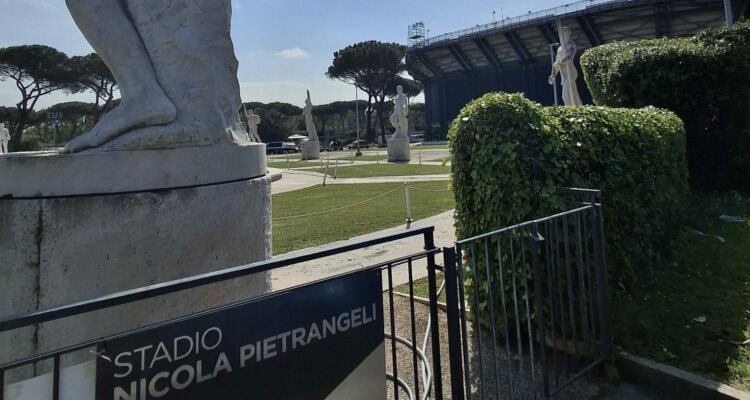
After Pietrangeli won a total of 53 titles in the amateur era of tennis, the Italian gentleman became a front-row fixture at Foro Italico in Rome for the Italian Open. In 2006, the 3,000-seat statue-lined Pallacorda court – considered by many to be one of the most picturesque tennis courts in the world – was renamed Stadio Pietrangeli in his honor.
“That court there,” Pietrangeli once told Tennis TV in a short film about him, “which is not the biggest, not the most important, [is] the most beautiful in the world. There’s nothing like this. It has my name on it.”
Honouring Italian tennis legend Nicola Pietrangeli ❤️ pic.twitter.com/ON96CrEDbp
— Tennis TV (@TennisTV) December 1, 2025
Pietrangeli is the only Italian player – man or woman – enshrined in the International Tennis Hall of Fame. It said of Pietrangeli, who was inducted in 1986, that he “had classic strokes, a conventional game plan, and and economy of effort that made him a supreme clay court player.”
Rafael Nadal, who won the Italian Open on clay a record 10 times, and often received the champion’s trophy from Pietrangeli, posted in Italian on X: “I just heard the sad news about the passing of an Italian and world tennis great. My sincerest condolences to his family, his son Filippo and the entire Italian tennis family. RIP Nicola.”
Ho appena saputo della triste notizia della partenza di un grande del tennis italiano e mondiale.
Le mie più sentite condoglianze a tutta la sua famiglia, il suo figlio Filippo, e tutta la famiglia del tennis italiano. DEP Nicola pic.twitter.com/rs1ql2vAU6
— Rafa Nadal (@RafaelNadal) December 1, 2025
A public viewing of Pietrangeli’s body will be held on the court named after him at Foro Italico on Wednesday, followed by a brief memorial service, the Italian tennis federation announced.
La camera ardente per Nicola Pietrangeli, scomparso oggi all’età di 92 anni, si terrà mercoledì sul campo a lui intitolato al Foro Italico, luogo simbolo della storia del tennis italiano e teatro di molti dei suoi successi. L’apertura al pubblico è prevista a partire dalle ore 9,… pic.twitter.com/jXm4zm6pZl
— FITP (@federtennis) December 1, 2025
Nicola Pietrangeli, an inconic figure in Italian tennis, leaves an extraordinary legacy. Nicknamed “The Captain” by his tennis peers, he embraced the joy and freedom of the sport he truly loved. No doubt, he will be greatly missed by the tennis world.