
MELBOURNE/WASHINGTON, February 1, 2026 (by Michael Dickens)
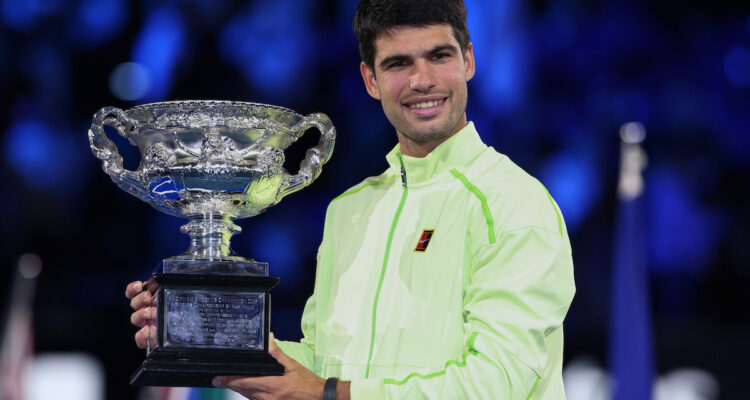
There was nothing but pure joy on the face of Carlos Alcaraz. It was evident after the World No. 1 became the youngest man to capture a career Grand Slam – winning all four majors – on an historic Sunday night at the Australian Open in Melbourne.
After the 22-year-old Spaniard outlasted 10-time Australian Open champion Novak Djokovic, 2-6, 6-2, 6-3, 7-5 in three hours and two minutes on Rod Laver Arena, with the roof partially closed to win his first AO title, a thunderous applause erupted from the crowd of 15,000 tennis enthusiasts. Everyone rose to their feet in appreciation after the top-seeded Alcaraz secured championship point on his first attempt.
Just a 22yo living his dreams pic.twitter.com/XLT6eorqcK
— #AusOpen (@AustralianOpen) February 1, 2026
The new AO champion dropped his racquet and fell to the ground, covering his face with his hands. When he lifted himself up, Alcaraz beamed a smile for all the world to see – and for the world to smile with him. Soon, Alcaraz and the World No. 4 and fourth-seeded Djokovic, who was competing in his 38th Grand Slam final, shook hands and shared a warm hug at the net. The 38-year-old Serbian great smiled proudly and congratulated him, patting him on the back as they walked off the court together. Then, Alcaraz raced over to share congratulatory hugs with his coach, Samuel Lopez, and the rest of his team as well as with his father, Carlos Sr., who was sitting nearby.
History
Career slam complete, take a bow @carlosalcaraz @wwos • @espn • @tntsports • @wowowtennis • #AO26 pic.twitter.com/pd7ye35TTq
— #AusOpen (@AustralianOpen) February 1, 2026
In a record-breaking performance, Alcaraz became the youngest man to complete winning a career Grand Slam at 22 years and eight months, which broke an 87-year record that had been held by American Don Budge since 1938, when he achieved a career Grand Slam at Roland-Garros just before turning 23. Als0, he’s the first player to complete the career Grand Slam at the Australian Open and the youngest player to win seven men’s major titles. Plus, he’s the second-youngest Spaniard to win the Australian Open after Rafael Nadal, who won the AO title twice, and was present to see history made in Melbourne.
Carlos Alcaraz right now
✅ At 22, the youngest ever player to complete the Career Grand Slam, breaking an 87 year record
✅ Does it by winning first #AusOpen title
✅ The youngest player to win x7 Men’s Grand Slam titles
✅ The second Spaniard to win the AO after Rafael… pic.twitter.com/qT0DS8MbpA— #AusOpen (@AustralianOpen) February 1, 2026
Alcaraz becomes the latest member of an esteemed list of present and future Hall of Famers – a who’s who of men’s tennis – to complete a career Grand Slam. It includes: Fred Perry, Budge, Rod Laver, Roy Emerson, Andre Agassi, Roger Federer, Nadal and Djokovic. Laver was a frequent visitor during this Melbourne fortnight; Federer paid a visit to the tournament during the first week of the main draw, and Nadal sat in the front row for Alcaraz-Djokovic final.
Ahead two sets to one, after an impressive start by Djokovic and tactical adjustments made by Alcaraz in the second and third sets – and serving at 4-all in the fourth set – Alcaraz saved a 30-40 break point and held serve for 5-4. Soon, at 5-6, Djokovic served in an attempt to push the title match to a tiebreaker – in hopes of winning it – and to force a decisive fifth set. However, Alcaraz had other plans.
The final game of the title match included a tense but exciting 24-stroke rally that was won by the young Spaniard. Then, after two errors by Djokovic, Alcaraz gained two championship points, ahead 15-40. He cashed it all in on the first one at 10:48 p.m. local time and won after Djokovic sailed a forehand long to end one last three-shot skirmish and a 62-minute fourth set. It prompted ESPN play-by-play announcer Chris Fowler to comment: “The greatest of his generation beat the greatest of all time.”
There’s no such thing as watching the championship-winning moment too many times, especially when it’s from this angle @wwos • @espn • @tntsports • @wowowtennis • #AO26 pic.twitter.com/DXud5ieTyo
— #AusOpen (@AustralianOpen) February 1, 2026
Overall, Alcaraz won 77 percent (51 of 66) of his first-serve points, hit 36 winners to 27 unforced errors and converted five of 16 break points. He outpointed Djokovic 118-106. By comparison, Djokovic won 66 percent (56 of 85) of his first-serve points, struck 32 winners, committed 46 unforced errors – including 31 in the final two sets – and broke Alcaraz twice in six tries.
En route to his first AO title, Alcaraz secured victories against Adam Walton, Yannick Hanfmann, No. 32 seed Corentin Moutet, No. 19 seed Tommy Paul, No. 6 seed Alex de Minaur in the quarterfinal round, No. 3 seed Alexander Zverev in the semifinals and No. 4 seed Djokovic in the final.
Alcaraz improved to 3-0 in major finals against Djokovic, who will move to No. 3 in the PIF ATP Rankings on Monday. Now, Alcaraz and Italy’s Jannik Sinner have won the last nine Grand Slam men’s singles titles, which has kept Djokovic stuck on 24 Grand Slam titles as he continues his quest for a 25th major crown and one that would make him the oldest player in the Open Era to win a major. It matches a similar dominance that Djokovic and Nadal achieved from the French Open in 2010 through the 2012 French Open, and trails the 11 titles compiled by Nadal and Federer between the 2005 French Open and the 2007 US Open.
History pic.twitter.com/FRpRxKb9Tr
— #AusOpen (@AustralianOpen) February 1, 2026
“Nobody knows how hard I’ve been working to get this trophy; I just chased this moment so much,” Alcaraz said during the trophy ceremony, just two days after enduring a five-set semifinal victory over Zverev, an odyssey that set a record for the longest Australian Open semifinal at five hours and 27 minutes.
In acknowledging the work of Lopez, who replaced departed long-time coach Juan Carlos Ferrero, and the rest of his team, he added: “We just did the right work, you were pushing me every day to do all the right things. I’m just really grateful for everyone I have in my corner right now. This trophy is yours.”
One team, one dream #AO26 pic.twitter.com/T9s2F2rJbC
— #AusOpen (@AustralianOpen) February 1, 2026
In receiving the Norman Brookes Challenge Cup for the first time, Alcaraz paid tribute to Djokovic, 16 years his senior, who lost the AO final for the first time after winning 10 Melbourne titles from 2008-23. It was the second-widest age gap in an Open Era major men’s singles final. “I enjoy so much watching you play, for me, it’s been an honor sharing the locker, sharing the court,” he said.
“Thank you very much for what you’re doing because as I said, this is really inspiring.”
Djokovic congratulated Alcaraz after receiving his finalist’s plate. Although he came up short, two nights after he unseated the two-time defending AO champion Sinner in a four-hour, nine-minute five-set semifinal to reach his 11th Australian Open final, he remained upbeat.
all emotion pic.twitter.com/zBL5KET6sp
— #AusOpen (@AustralianOpen) February 1, 2026
“First and foremost, congratulations to an amazing tournament and amazing couple of weeks,” Djokovic said, after losing to Alcaraz for the fifth time in 10 career meetings.
“What you’ve been doing, the best word to describe is historic, legendary, so congratulations. I wish the best of luck in the rest of your career.
“You’re so young, you have a lot of time, like myself,” he added, with a sense of humor.
“I’m sure we’ll be seeing each other many more times in the next 10 years, yeah … not!”
Another brilliant fortnight from our 10x champ
It’s always a pleasure to have you in Melbourne, @DjokerNole pic.twitter.com/gSXFAFcBHh
— #AusOpen (@AustralianOpen) February 1, 2026
Later, during his news conference, Djokovic continued to praise Alcaraz. He said: “He definitely is one of the best players I’ve ever faced in my career.
“He makes you play your best tennis in order to beat him. …
“The results are a testament to his already stellar career. I can’t think of any other superlatives about him.”
“The youngsters like myself are still trying to catch up.” @DjokerNole still has his sense of humour even after a first #AusOpen Final loss. pic.twitter.com/qlzMEGt6Qb
— #AusOpen (@AustralianOpen) February 1, 2026
Meanwhile, Alcaraz said in his news conference the one thing he’s learned this year is to appreciate and enjoy every single second of the moment he’s been living. “Not only lifting the trophies, but playing tournaments, playing tennis, getting victories, getting losses. Whatever it is, just enjoy and appreciate the life you’re living,” he said.
“So, right now, I’m just trying to have a time to realize what I’ve been doing. … For me, it’s an honor to put my name on the history books.”
AND WE DID IT!!! ❤️ pic.twitter.com/V1cjC20T4V
— Carlos Alcaraz (@carlosalcaraz) February 1, 2026
Nadal returns to Melbourne Park
Rafael Nadal returned to the Australian Open for the first time since he retirement and sat front row center for the men’s final between Carlos Alcaraz and Novak Djokovic. The two-time AO champion (2009, 2022) was on hand this weekend to mark KIA’s 25th anniversary as a long-standing Australian Open major partner and for the “Night of Legends” event before Sunday’s men’s singles final.
In 2012, Nadal and Djokovic played the longest match ever at the AO, a five-set final that lasted nearly six hours that was won the Serbian great. It was the third of Djokovic’s 10 Australian Open singles titles.
“Wanna play, Rafa?” pic.twitter.com/lg2tnYE5zc
— #AusOpen (@AustralianOpen) February 1, 2026
In an interview with the Australian Open website, Nadal said he’s at peace with not being the focus of everyone’s attention in Rod Laver Arena.
“That part of my life is over,” Nadal said. “Of course it’s forever going to be in my heart.
“I have a completely different mindset. Much more relaxed. No pressure at all.
“It’s going to be a pleasure to watch the final [in person]. I haven’t been in a professional match for a while. I just want to enjoy another great battle and a great level of tennis.”
Alcaraz winning his first #AusOpen title AND becoming the youngest to complete the Career Slam, in front of his idol, Nadal – this is why we pay our internet bills pic.twitter.com/qsAVxy0Pbq
— #AusOpen (@AustralianOpen) February 1, 2026
During the trophy ceremony Sunday evening, both players acknowledged the 22-time major champion in their remarks.
“I want to speak to the legendary Rafa, who is in the stands,” Djokovic said, smiling. “Obviously, it feels very weird to see you there and not here, you know?
“But thank you for being present. It’s too many Spanish legends. … It felt like it was two against one tonight, you know, it wasn’t fair, but OK.”
From Novak, to Rafa. From one legend to another pic.twitter.com/gsxs91w4ku
— #AusOpen (@AustralianOpen) February 1, 2026
When it was Alcaraz’s turn to speak, he said it was a privilege to play in front of Nadal. “I know you were watching me when I was like 15, 14-years-old. So, it’s been a long time. But, yeah, for me, it’s such an honor playing in front of you.”
A legend watching another in the making; tennis, you beauty @RafaelNadal • @carlosalcaraz • #AO26 pic.twitter.com/sKE4AArTZ1
— #AusOpen (@AustralianOpen) February 1, 2026
Sesko is first Slovenia AO junior boys’ champion
Ziga Sesko, a 17-year-old from Hrastnik in central Slovenia, is the first Slovenian to win a junior boys’ singles Grand Slam title. Sunday afternoon on Rod Laver Arena, Sesko defeated Keaton Hance of the United States, 4-6, 6-3, 6-4, in one hour and 57 minutes.
“Winning a Grand Slam is, I think, what every kid is dreaming of,” Sesko said, quoted by the Australian Open website. “To be able to actually achieve it … I don’t even feel it now, but I’m sure tomorrow or later on I will feel very, very special.”
From a set down to champion
Ziga Sesko defeats Keaton Hance 4-6 6-3 6-4 to win the Australian Open Junior Boys’ Singles title.@wwos • @espn • @tntsports • @wowowtennis • #AO26 pic.twitter.com/SSFJekRoww
— #AusOpen (@AustralianOpen) February 1, 2026
Sesko hit 32 winners – five of them aces – and broke Hance’s serve four times in seven tries. He outpointed his opponent 92-82 and won on his third championship point opportunity.
En route to the title, Sesko eliminated No. 2 seed Luis Miguel of Brazil in the quarterfinals and No. 3 seed Ryo Tabata of Japan in the semifinals.
Now, Sesko is off to join his country’s Davis Cup team ahead of its tie against Turkey on Friday.
View this post on Instagram
Efremova is first French AO junior girls’ champion since 1999
As soon as 16-year-old Ksenia Efremova of France secured match point to win the Australian Open junior girls’ title over Ekaterina Tupitsyna of Russia, 6-3, 7-5 – the first French girl to win the AO junior girls’ title since Virginia Razzano in 1999 – she was on her mobile phone talking to her mom, former pro Yulia Efremova, back home in Alpes-Maritimes, France near Nice.
“It’s always kind of a tradition when I’m winning a tournament, every time I call her, or even semis. … Even if she sleeps, doesn’t matter,” the No. 3 seed Efremova told the Australian Open website.
“I wanted to wake her up with the good news.”
Your 2026 #AusOpen Junior Girls’ Singles Champion is Ksenia Efremova
She defeats Ekaterina Tupitsyna 6-3 7-5 to win the Championship.@wwos • @espn • @tntsports • @wowowtennis • #AO26 pic.twitter.com/PgZFU9MtRt
— #AusOpen (@AustralianOpen) February 1, 2026
Efremova, who was born in Russia but moved to France in 2019 to train at the Mouratoglou Academy, said she received some advice from Top-10 player Alexander Bublik on how to handle playing on Rod Laver Arena, a court she admitted was slower than playing on Margaret Court Arena for the semifinals.
“I know that Bublik also said it was slower, and I was kind of already prepared that it’s going to be different, but it’s huge,” she said.”
By the end of the final, Efremova had outpointed the unseeded Tupitsyna 70-65. She hit five winners and converted seven of 11 break points. Although Tupitsyna hit 21 winners, she also made 45 unforced errors.
Efremova, who is currently ranked No. 583 on the WTA Tour, said her goal is become Top 200 to be able to enter the qualifications for the Grand Slams and other tournaments.
View this post on Instagram
Around the Australian Open
On the 50th anniversary of his 1976 AO title, Australian Mark Edmondson presented the Norman Brookes Challenge Cup to new champion Carlos Alcaraz. … American actress and Louis Vuitton Ambassador Chloë Grace Moretz and 2000 Australian Open champion Marat Safin presented the Norman Brookes Challenge Cup in its bespoke Louis Vuitton trophy trunk. … Fijian-Australian singer/songwriter Pauline Curuenavuli, known professionally as Paulini, sang the Australian National Anthem.
By the numbers
• By winning his seventh major title, Carlos Alcaraz is now tied for ninth place on the all-time list with John McEnroe, who was in Melbourne commenting on the final for ESPN, and Mats Wilander, who was also at the AO as a pundit for Discovery + UK. Alcaraz has won one Australian Open title (2026), two French Open titles (2024-25), two Wimbledon Championships crowns (2023-24) and two US Open titles (2022, 2025).
Walk of champions ft. @carlosalcaraz, now a reality pic.twitter.com/S9q3ffnO7X
— #AusOpen (@AustralianOpen) February 1, 2026
• Carlos Alcaraz has won his first Australian Open title at age 22, the same age as when Roger Federer and Rafael Nadal won their first AO crowns.
• The final day attendance at Melbourne Park was 56,931, which broke the previous Final Sunday attendance record of 46,526 set last year. This year’s main draw attendance was 1,150,044, also a record. The previous record was 1,102,303, set in 2025. The Australian Open 2026 total attendance was 1,368,043, a record, breaking the old mark of 1,218,831 set last year.
“Quotable …”
“With Novak, we had an amazing story. All those years competing for the most important things.
“I think it is a positive example of commitment, resilience and in some ways it’s a positive thing to have somebody like him, at his age, fighting with the players that are younger and they are at the prime.
“Novak, for obvious reasons, he’s not at his prime, but still very, very competitive at an age that is difficult to be very competitive now. So full respect, full credit to him.”
– Rafael Nadal, 22-time major champion, as quoted by the Australian Open website, on the eve of the men’s singles final.